


Process Implementation & Training
We Want Your Team to Love Using HubSpot
When HubSpot doesn't match how your team actually works, they'll find a way around it every time.
We’ll make them fall in love with the portal.
Book a Call.893cdokW.svg)
Use Your HubSpot Every Day
Stop Using Spreadsheets When You Have HubSpot
A CRM your team doesn't use is just an expensive contact list.
The Problem
 The solution
We redesign the process first, so HubSpot reflects how your team actually works.

Logging a deal feels like extra administrative work rather than a natural part of the job.
We remove the friction points that cause people to avoid the system.
The team avoids HubSpot because the configuration creates friction.
We train them on your specific portal, using your real data and pipelines.
People find a faster way to do their work, which usually means spreadsheets.
We create a system where using HubSpot is genuinely the fastest way to do their job.
You train them on generic HubSpot features, not on their specific daily tasks.
How We Approach Process Implementation & Training
Step 01
Process Shadowing
We observe how your team actually works before we recommend any changes. We want to understand where the friction is, where HubSpot is being avoided, and why, before we touch anything.
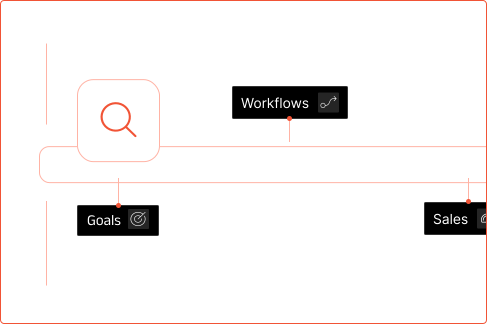
Step 02
Gap Analysis
We map the distance between how your team currently operates and how HubSpot is configured, then identify the specific points where the two diverge and create the most resistance.
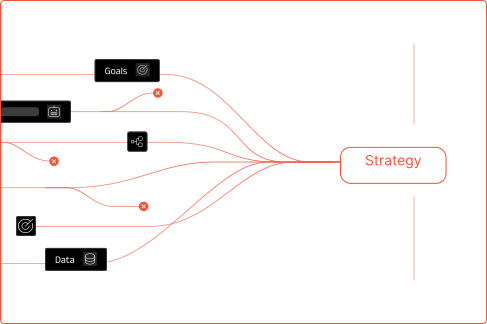
Step 03
Process Redesign
We redesign the workflows and processes that are creating friction, removing unnecessary steps and aligning the new process with HubSpot's capabilities so the two work together naturally.
.C2etm86B.svg)
Step 04
Contextual Training
We train your team on your portal, using your data, your pipelines, and your real scenarios. The goal is that every person can do their job inside HubSpot without needing to ask for help.
.Bqj4iMYh.svg)
Step 05
Post-Launch Reinforcement
We follow up after go-live to see which new habits have taken hold and which haven't. If something isn't sticking, we adjust the training or the configuration to ensure everyone knows the portal.
.BETvvrIp.svg)
Step 01
Process Shadowing
We observe how your team actually works before we recommend any changes. We want to understand where the friction is, where HubSpot is being avoided, and why, before we touch anything.
Step 02
Gap Analysis
We map the distance between how your team currently operates and how HubSpot is configured, then identify the specific points where the two diverge and create the most resistance.
Step 03
Process Redesign
We redesign the workflows and processes that are creating friction, removing unnecessary steps and aligning the new process with HubSpot's capabilities so the two work together naturally.
Step 04
Contextual Training
We train your team on your portal, using your data, your pipelines, and your real scenarios. The goal is that every person can do their job inside HubSpot without needing to ask for help.
Step 05
Post-Launch Reinforcement
We follow up after go-live to see which new habits have taken hold and which haven't. If something isn't sticking, we adjust the training or the configuration to ensure everyone knows the portal.
Results
The ROI of Process Adoption
Real adoption means your teams open HubSpot first every day because it's genuinely the fastest and most reliable way to do their job.
.DufQsTuc.svg)
True Adoption
Your team stops building workarounds and starts working inside the system because the system actually works for them.
.GAOfPNCY.svg)
Institutional Knowledge in the System
The undocumented process knowledge that used to live in individual people's heads, becomes documented and now lives permanently in HubSpot.
.7OAl9awo.svg)
Consistent Data Quality
When everyone enters data the same way because the process makes it seamless, your reporting becomes something you can actually trust.
.CURQ89ul.svg)
Faster Onboarding for New Hires
New team members can get up to speed quickly because the process is documented, the training is contextual, and the system is intuitive.

A Portal That Gets More Valuable Over Time
The longer your team uses HubSpot consistently, the richer your data becomes and the more powerful your reporting and automation get.

Don't Just Take Our Word For It
Training Outcomes in Practice
Partnering with Bryant Works was a game changer! Their expertise and strategic approach have been invaluable.
Valentina ArtunduagaCreative Operations Manager @ storyarb - CASE STUDY
- B2B Content Marketing
Revenue Reporting
Bryant Works' strategic implementation of HubSpot solutions transformed storyarb's operational capabilities, providing the tools and insights necessary for sustainable growth.
Read case studyBryant Works was the right choice. It's clear they actually care about setting you up for success.
Ellery FinkHead of Customer Experience @ Vori - CASE STUDY
- SAAS
HubSpot Customer Onboarding
Through thoughtful collaboration and expert implementation, Bryant Works helped Vori turn an underperforming HubSpot instance into a powerful onboarding engine.
Read case studyThe team was responsive, strategic, and genuinely easy to work with. Bryant Works helped us hit a critical milestone with confidence.
Kevin KeithVP of Sales & GTM Strategy @ RedBeam - CASE STUDY
- SAAS
Website Relaunch
From day one, Bryant Works prioritized alignment. The team didn't overcomplicate the process — they leaned into what mattered most: speed, quality, and communication.
Read case study






Next Steps
Ready to Turn Your Team Into HubSpot Power Users?
Let's start with how your team actually works, not a generic training deck.


.BGz6aR8w.svg)



FAQs About HubSpot Consulting

Do you train our team on our actual portal or a demo environment?
We train exclusively on your live portal using your actual data, your real pipelines, and the workflows your team will use every day. Generic HubSpot training teaches people how the software works in theory. We teach your team how to do their specific job inside the specific system they'll be working in.
How long does process implementation and training take?
The timeline depends on the size of your team and how much process redesign is needed before training begins. Process shadowing and redesign typically take 2 to 4 weeks. Training rollout follows from there, with the total engagement usually running 6 to 10 weeks for mid-sized teams.
What if team members are still struggling after training?
We build post-launch reinforcement into every engagement. We check back in after go-live to identify what's working and what isn't. If a specific process is still creating friction, we either adjust the training approach or revisit the configuration to remove the obstacle.
Can you help us document our processes as part of this engagement?
Yes, and we strongly recommend it. Undocumented processes exist only in people's heads, which means they change every time someone new joins the team. We document every redesigned process clearly so your team has a reliable reference point and new hires can onboard without relying on tribal knowledge.
We already did HubSpot training when we first bought it. Why isn't it working?
Onboarding training from HubSpot or a generic partner is typically focused on platform features, not on your specific business. It teaches people what HubSpot can do, not what your team should do inside it. If adoption is low, the training didn't connect the platform to the process. That's exactly what we fix.
Who should be involved in the process shadowing phase?
We need to observe the people actually doing the daily work across your teams, not just leadership. Leadership tells us how the process is supposed to work, but the front-line users show us how it actually works and where the friction points are hiding.
Do you train administrators as well as end-users?
Yes. While end-user training focuses on daily workflows and adoption, we also provide specialized training for your internal HubSpot administrators. This ensures your operations team can maintain the newly designed processes, update pipelines, and build reports independently.
How do you handle pushback from team members who don't want to change?
Resistance to change usually comes from systems that make people's jobs harder. Because we redesign the process to remove friction before we train, we can show resistant users how the new system actually saves them time. When the tool serves the user, adoption naturally follows.
Can this service be combined with a portal optimization or custom build?
Absolutely. In fact, process redesign and training are natural extensions of both services. Whether we are cleaning up technical debt or engineering custom objects, we always recommend pairing structural changes with contextual training to ensure the new architecture is actually adopted.
Do you provide training materials we can use for future hires?
Yes. Alongside live training sessions, we deliver recorded walk-throughs and written documentation based on your specific portal and processes. This creates a permanent onboarding asset so new hires can get up to speed without requiring you to repeat the training every time your team grows.