Step 01
A Comprehensive Audit
We map your team's daily workflows to find the tasks that repeat, the handoffs that stall, and the follow-ups that fall through the cracks.
AI Agents & Automation
Your processes have more automation potential than you think. Let’s unlock the full automation potential of your HubSpot portal.
HubSpot AI Tools & Workflow Automation
Stop wasting brainpower on something that HubSpot can handle.
Step 01
We map your team's daily workflows to find the tasks that repeat, the handoffs that stall, and the follow-ups that fall through the cracks.
Step 02
Not every automation is worth building. We rank opportunities by time saved and error reduced so we build what moves the needle first.
Step 03
We configure workflows and AI agents to match how your team actually operates as well as to support your goals.
Step 04
Every automation is tested before it touches your live data so nothing breaks in production.
Step 05
We document every automation and walk your team through what it does and why, so they trust it and use it instead of working around it.
Step 01
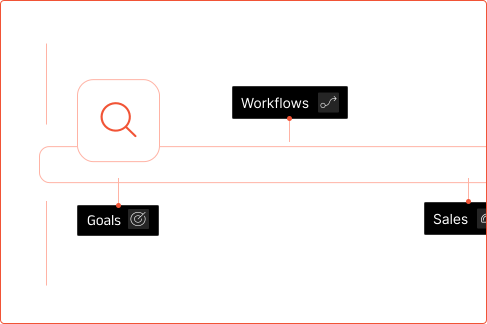
We map your team's daily workflows to find the tasks that repeat, the handoffs that stall, and the follow-ups that fall through the cracks.
Step 02
Not every automation is worth building. We rank opportunities by time saved and error reduced so we build what moves the needle first.
Step 03
We configure workflows and AI agents to match how your team actually operates as well as to support your goals.
Step 04
Every automation is tested before it touches your live data so nothing breaks in production.
Step 05
We document every automation and walk your team through what it does and why, so they trust it and use it instead of working around it.
Results
When you leverage the power of Agentic AI, you free up your team’s time and focus for other important tasks.
When the system handles the data entry, your team gets those hours back to focus entirely on closing deals.
The lag where deals typically stall disappears. Transitions between marketing, sales, and success happen immediately and automatically.
Your CRM stays clean automatically. The system updates its own fields based on behavior, keeping your reporting accurate.
Workflows that previously required constant manual supervision now run quietly and reliably in the background, exactly as designed.
Don't Just Take Our Word For It
Partnering with Bryant Works was a game changer! Their expertise and strategic approach have been invaluable.
Bryant Works' strategic implementation of HubSpot solutions transformed storyarbs's operational capabilities, providing the tools and insights necessary for sustainable growth.
Read case studyBryant Works was the right choice. It’s clear they actually care about setting you up for success.
Through thoughtful collaboration and expert implementation, Bryant Works helped Vori turn an underperforming HubSpot instance into a powerful onboarding engine.
Read case studyThe team was responsive, strategic, and genuinely easy to work with. Bryant Works helped us hit a critical milestone with confidence.
From day one, Bryant Works prioritized alignment. The team didn't overcomplicate the process — they leaned into what mattered most: speed, quality, and communication.
Read case studyNext Steps
We can identify the exact bottlenecks where manual effort is slowing your team down, and build the automation to remove them.
Workflows are rule-based automations that trigger actions when specific conditions are met, like sending an email when a deal moves to a new stage. AI agents go further as they can interpret context, make decisions, and take multi-step actions without a human defining every condition in advance. Both are powerful, and the right mix depends on the complexity of your processes.
We start with a time audit. The processes worth automating are the ones that repeat frequently, follow a consistent pattern, and currently require a human to initiate or complete them. We rank opportunities by time saved and error reduction before building anything, so you get the highest-impact automations first.
Yes. Many of the most valuable automations connect HubSpot to other platforms in your stack, whether that's your ERP, your customer success tool, your project management system, or your communication platforms. We assess whether native connectors, third-party middleware, or custom builds are the right approach for each connection.
Not if it's built correctly. We test every automation before it touches your live data. We document key automations so your team has visibility into what’s running and can spot when something isn’t behaving as expected.
It depends on the complexity and volume of what you're building. A single high-impact workflow can be built and deployed in a matter of days. A full automation audit and build-out across multiple processes typically takes 3 to 6 weeks. We scope this during discovery so there are no surprises.
Automations need to be maintained as your business evolves. We document everything we build so your team can make straightforward updates independently. For more complex changes, we offer ongoing support engagements that keep your automation layer current as your processes grow.
Some AI features are tier-dependent, yes. During discovery, we assess what's available in your current subscription and identify whether upgrading specific hubs would unlock meaningful automation value. We never recommend an upgrade unless the ROI is clear.
Yes, and we do it regularly. Inherited automation is one of the most common issues we see like workflows that were built for a process that no longer exists, or that run silently in the background creating data problems nobody has traced back to the source. We audit what's there, document what's running, and clean up what's broken.
We build reporting into every automation engagement so you can see what's firing, how often, and what outcome it's producing. For time-saving automations, we establish a baseline before we build so the before-and-after comparison is concrete.
Automation is a component of RevOps, not a substitute for it. Automating a broken process just makes the broken process faster. We always start with process design before we build automation, which means the workflows we deploy are built on a foundation that makes sense for your business, not just a faster version of what you were already doing wrong.